





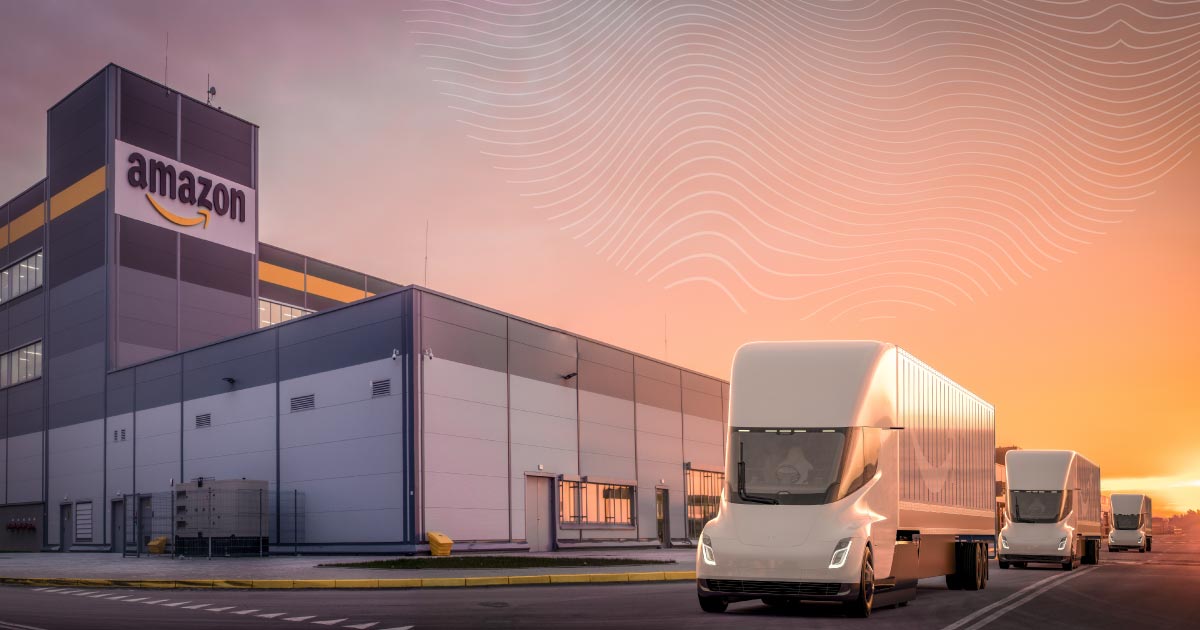


On May 4, 2026, FedEx lost $3.2 billion in market capitalization before lunch. UPS shed $2.1 billion. Neither company had reported earnings, and neither had issued a profit warning. Amazon had simply announced it would ship your products — even if you have never sold a single item on its marketplace.
That reaction tells the story more cleanly than any analyst note. Amazon Supply Chain Services is not a new logistics product. It is a structural reclassification: Amazon is now a logistics utility that operates a marketplace, rather than a retailer that built logistics to support one.
For retail leaders, the question has shifted. It is no longer about how to compete with Amazon on delivery speed or fulfillment cost. It is whether Amazon’s network is the right infrastructure for your business to operate on — and what you give up if it is.
The Old Competitive Logic No Longer Holds
For a decade, the dominant retail strategy playbook treated Amazon as a channel decision with a calculable downside: sell through Marketplace, and you surrender customer data, margin, and brand control. The alternative — building an independent logistics capability or contracting with established 3PLs — preserved those relationships at a higher cost. That trade-off made sense when Amazon’s infrastructure was inaccessible to non-Amazon sellers.
ASCS eliminates that condition. A brand operating entirely through its own DTC site can now access Amazon’s fulfillment network, its AI demand-forecasting, and its last-mile delivery speed — without listing a single product on Marketplace. The brand relationship stays direct. The logistics layer becomes Amazon.
The financial case is concrete, if partially self-reported. Mid-market brands switching to ASCS report per-order fulfillmentt and last-mile cost reductions of 1- 25 percent (Amazon, 2026). Sellers on the fully managed service qualify for 25 percent lower storage fees and 15 percent lower transportation costs versus fragmented 3PL arrangements. Amazon now handles an estimated 25 percent of U.S. parcel volume — a scale advantage Morgan Stanley analysts describe as structurally difficult for carriers to close within a five-year horizon.
“Amazon has not entered the logistics market. It has redefined who the logistics market is. Fulfillment. Every carrier that assumed enterpris-gistics was theirs to lose is now reckoning with the consequences.”
Why Legacy Carriers Cannot Close the Gap
The market’s response to ASCS was not an overreaction. It was an accurate read of a structural asymmetry that has been compounding for years.
Amazon’s logistics cost base differs from FedEx or UPS for a straightforward reason: it was never built as a logistics business. It was built as the operating infrastructure for a $ 600 billion retail and cloud enterprise. Every dollar invested in fulfillment centers, cargo aircraft, and delivery routing was justified by Amazon’s own volume. The cost of extending that network to third parties is substantially lower than building equivalent capacity from scratch — lower in ways that legacy carriers, whose infrastructure investment requires standalone commercial justification, cannot easily replicate.
What legacy carriers retain that Amazon does not is neutrality — and its value depends entirely on category. For brands competing directly with Amazon’s own private-label lines — electronics accessories, basic apparel, household consumables — the data risk is real and specific. Amazon’s inventory positioning AI learns from demand signals. Feeding it your sales, customer location, and basket composition data in those categories is not a logistics decision. It is competitive intelligence tailored to a company operating in your market.
The parallel to AWS is instructive. Amazon built its cloud infrastructure to run its own retail operations, then opened it to third parties — including retailers who now depend on AWS to compete with Amazon’s own marketplace. ASCS follows identical logic. Infrastructure becomes available. Dependency deepens. The switching cost rises with each fulfillment center integrated, each demand forecast calibrated, each inventory pool unified. Enterprise buyers who have lived through AWS lock-in will recognize the architecture.
For brands in categories where Amazon has no private-label exposure — specialty food, industrial supply, luxury goods, complex home goods — the conflict argument is weaker. The neutrality premium that FedEx and UPS charge is only worth paying when the alternative represents a genuine competitive risk. In those categories, it increasingly doesn’t fulfill
Questions Every Operations Leader Must Answer
ASCS does not produce a single answer. It produces a decision that every retail operations and supply chain leader needs to work through systematically — because the cost of defaulting to the status quo is now measurable.
The first question is category conflict. Where does Amazon’s private-label footprint overlap with yours? That overlap defines the perimeter of genuine data risk. Outside it, the conflict argument is largely theoretical.
The second question is margin architecture. For brands where a 15 to 25 percent reduction in fulfillment costs is the difference between DTC viability and marketplace channel dependency that extracts margins, ASCS restructures the business’s financial model. The operational savings may fund the brand investment needed to build a direct customer relationship worth protecting.
The third question is the delivery standard. Amazon Prime’s average delivery time in major U.S. markets now runs at 1.4 days (Convey, 2025). ASCS extends that expectation to every independent retailer on its network. Brands that cannot meet a comparable standard — regardless of carrier — will lose conversion at the comparison stage. The question is not whether to meet it. It is whether ASCS is the most efficient path to dosavings.
| WHAT THIS MEANS FOR RETAIL LEADERS
The ASCS decision is not a procurement question. It is a strategic one — involving customer data ownership, competitive category overlap, and long-term infrastructure dependency. Treating it as a cost-reduction exercise misframes the decision. The AWS parallel is the right frame. Amazon converts internal infrastructure into external dependency layers. That is the pattern with AWS, with Marketplace, and now with ASCS. Brands that adopt ASCS without mapping their exit conditions are not making a logistics decision — they are making a platform dependency decision. The brands most exposed are those that do nothing. Legacy carrier rates, fragmented 3PL costs, and a delivery-standard gap versus Amazon-enabled competitors compound. A structured ASCS assessment, mapped by category conflict, margin impact, and delivery gap, is the prerequisite for any rational decision. |
The Decision Retail Leaders Are Actually Making
Amazon becoming infrastructure does not make it a neutral actor. It makes the decision harder — and the analytical work more important.
The brands that navigate ASCS well will be those that map their category exposure before committing, define delivery standards they will and will not cross, and build on what AWS adoption taught enterprise IT leaders a decade ago. The brands that struggle will be those that treat it as a binary: adopt wholesale or reject on principle. Neither position survives commercial pressure for long.
Today's Top Stories:
FROM OUR PARTNERS


